Aymaro of Alessandria
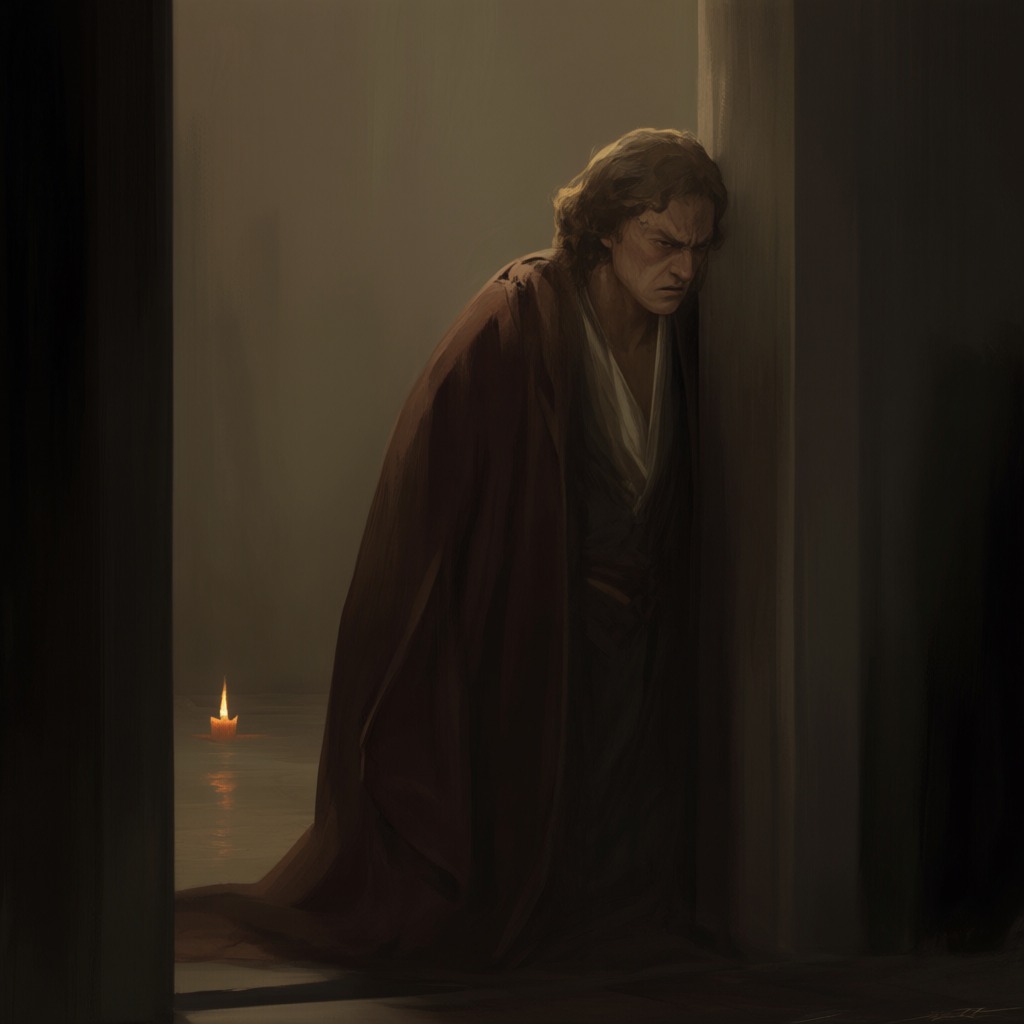
Aymaro of Alessandria is a monk of the abbey whose perpetual sneer and caustic tongue mark him as a persistent critic of the abbey's leadership and its isolation from the changing world. He represents a faction of Italian monks who resent the dominance of foreigners in the library and the abbey's refusal to engage with the commercial and political currents of the Italian cities. His observations, though often delivered with a mocking air, provide a running commentary on the tensions and hypocrisies that underlie the community's pious surface.
Identity and Background
Aymaro is introduced in the scriptorium, where his face is described as bearing "a perpetual sneer, as if he could never reconcile himself to the fatuousness of all human beings and yet did not attach great importance to this cosmic tragedy." This expression defines his narrative role: he is a detached, ironic observer who sees the folly around him but is not moved to reform it. He is an Italian monk in an abbey where, as he complains, the library has been "handed over to foreigners" and the abbot "counts for nothing." His identity is rooted in a sense of regional pride and a belief that the abbey should reflect Italian interests and adapt to the new realities of the Italian city-states.
Views on the Abbey and Its Governance
Aymaro is openly critical of the abbey's direction. He laments that the abbey no longer rules the world as it once did, saying, "Once our abbeys ruled the world. Today you see the situation: the Emperor uses us... but if he wants to control the affairs of this country, he remains in the city." He contrasts the abbey's focus on preserving ancient books with the dynamic commercial life of the cities below, where "they trade lengths of silk for pieces of linen... and all of them for good money." He argues that the abbey should open itself to texts in the vernacular and engage with the merchants and scholars of Florence and Pisa, rather than being controlled by "a group of foreigners who continue to manage the library as if the good Odo of Cluny were still abbot." His critique extends to the abbot himself, whom he describes as having "a bookcase" in place of his head, "wormeaten."
Role in the Abbey's Conflicts
Aymaro is a central figure in the faction of Italian monks who resent the succession of foreign librarians. After the death of Malachi of Hildesheim, he is part of the group that discusses the need for a new librarian who is "worthy, and mature, and wise" and who knows Greek and Arabic, as tradition demands. He is present when the Italians, led by Alinardo of Grottaferrata, confront the abbot, and he is described as supporting the reluctant Alinardo toward the abbatial residence. His sneering commentary on the abbey's affairs often carries a subversive edge, as when he remarks after Malachi's death, "With the German dead, there was the risk of having a new librarian even more barbarous." He also makes a pointed, anonymous remark during the trial of Remigio of Varagine, shouting, "You hid his letters and he showed you the novices' asses in the kitchen!" — a calculated insult that exposes the cellarer's role as a procurer and further embarrasses the abbot.
Narrative Significance
Aymaro functions as a chorus-like figure whose cynical observations provide a counterpoint to the official piety of the abbey. He is the voice of worldly pragmatism, skeptical of both the mystical fervor of Jorge of Burgos and the political maneuvering of the abbot. His sneer and his gossipy, insinuating manner make him an unreliable but revealing source of information about the abbey's internal politics. He is not directly involved in the central crimes, but his presence underscores the theme of institutional decay and the conflict between tradition and change that pervades the novel. His final appearance, after the fire, is not recorded, but his earlier words — "If justice existed, the Devil would come and take him this very night" — spoken of Malachi, resonate with the novel's exploration of divine and human justice.